1 min read
5-Week Disruption to Kansas Courts Caused by Foreign Cyberattack
It’s easy to miss news of the cybersecurity threats and attacks happening almost everywhere. At PK Tech, our goal is to educate and offer proactive...
3 min read
Jordan Hetrick
:
July 6, 2026
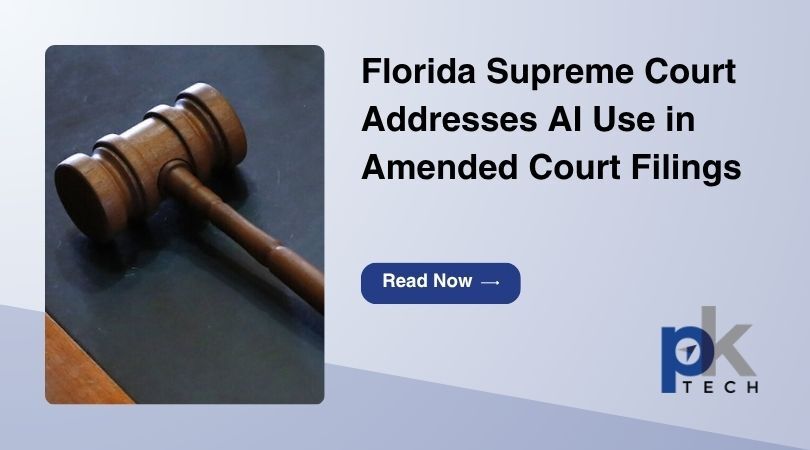
Fabricated case citations have a way of getting noticed. A judge reads a brief, looks up the case a lawyer cited, and finds nothing. No docket number, no opinion, no record that the case ever existed. That scenario has played out often enough across the country that the Florida Supreme Court decided to stop treating it as a one-off problem and start writing it into the rules.
On May 28, 2026, the court amended Florida Rule of General Practice and Judicial Administration 2.515(d)(2), creating a single statewide standard for how AI-generated content can appear in filings (Case No. SC2026-0673). The amendment took effect June 15 and now requires every person who signs a court filing, whether a licensed attorney or someone representing themselves, to certify that the legal authorities cited in that filing actually exist and are described accurately.
Generative AI tools have moved from novelty to standard practice in legal research and drafting over the past few years. The court's own commentary on the rule change acknowledges this directly, noting that large language models and similar systems are now regularly used as research and drafting aids in preparing filings. The problem is that these tools can produce text that reads with total confidence while citing cases, quotations, or holdings that were never written by any judge. The court referred to this output as convincing but nonexistent material, a description that shows why the problem is so easy to miss until it's too late.
Before this amendment, individual circuit courts in Florida had started writing their own local orders to deal with AI-related citation problems. Some required disclosure when AI tools were used. Others focused only on verification duties. The result was a patchwork that varied depending on which courthouse handled a given case. The Supreme Court's commentary states plainly that the amendment was adopted to create one uniform statewide rule in place of those scattered local orders. An accompanying administrative order, AOSC26-12, goes a step further by preempting local AI-filing rules statewide, meaning individual circuits can no longer set their own requirements.
The new rule language does not ban the use of generative AI tools in legal work, nor does it require lawyers to disclose when an AI tool assisted them with research or drafting. There is no checkbox, no standard disclosure form, and no statewide language mandating an admission of AI use.
What the rule requires instead is accuracy. A signer is certifying that the cases cited are real and that they are characterized correctly, regardless of how that citation was produced.
The amendment also gives judges clearer authority to sanction a filing that contradicts that certification. Courts can act after giving the signer notice and a chance to respond, and the available sanctions go beyond a simple warning. This addition matters because, as the court explained, the goal was to eliminate any uncertainty about whether judges already had authority to address AI-related citation errors under the prior framework.
State courts nationwide have been documenting and responding to AI-related filing problems for several years. The Supreme Court of Ohio maintains a public resource library tracking state-by-state responses, including interim policies from New Jersey, Pennsylvania, Utah, and several other states that address how AI tools should and should not be used in court documents.
California has taken a somewhat different path. Rather than adopting a statewide certification rule like Florida's, the Supreme Court of California has issued public warnings that AI tools can produce inaccurate output and that the person filing a document remains responsible for its accuracy, regardless of which tool helped prepare it.
The underlying numbers help explain why courts keep returning to this issue. A Stanford-led study of AI legal research tools found hallucination rates between 17 and 33 percent, even among tools built specifically for legal work and marketed as more reliable than general-purpose chatbots. That is a meaningful error rate for a profession where a single fabricated citation can derail a motion, delay a case, or draw sanctions against the filer.
The practical message from Florida's rule is that AI tools are not going away from legal practice, and courts are not trying to push them out. What courts are doing is making explicit what was already true under existing professional obligations: the person who signs a filing is responsible for its accuracy. Using an AI tool to draft a motion or locate supporting authority does not transfer that responsibility to the software.
For Florida attorneys specifically, that means treating every AI-assisted citation the way a careful researcher would treat any unfamiliar source, by checking it against the actual case before it goes anywhere near a filing.
For litigants and firms outside of Florida, the lesson still applies even if rules differ slightly. Courts in multiple states are converging on the same expectation, and the safest assumption is that verification, not disclosure, will define how AI tools are used in legal work going forward.
If your firm handles matter management, eDiscovery, or client files subject to bar confidentiality rules, PK Tech can help you evaluate AI use against those obligations. With 16 years of experience supporting businesses like yours, we maintain AICPA's SOC 2 Type II attestation, verified through an independent third-party audit of our security and privacy controls. Contact us to schedule a call with our team.
1 min read
It’s easy to miss news of the cybersecurity threats and attacks happening almost everywhere. At PK Tech, our goal is to educate and offer proactive...
1 min read
We're an MSP for accounting firms, and we see it all. Over the past several years, offshore labor has become increasingly common in the CPA space....
1 min read
Artificial intelligence (AI) is changing the world as we know it, and the realm of accounting is no exception.