3 min read
How Local Regulations in Arizona Affect Your Managed IT Security Requirements
Jordan Hetrick
:
December 30, 2026
As a proud local provider for Arizona businesses, we intimately understand what it means to survive (and thrive) as a business in our state.
It’s more than just surviving summer temps pushing 110 (although, yes, that sometimes plays a factor in our approach to IT as well).
Like any state, we have a set of unique challenges and advantages. Part of our job and expertise is helping clients navigate not only technical challenges but also the regulatory landscape that directly influences how you must protect sensitive data and maintain IT security.
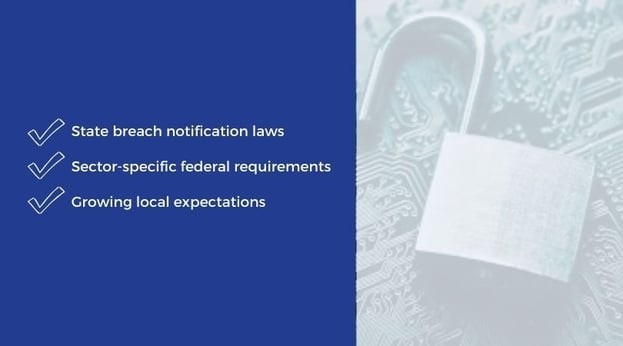
In Arizona’s legal environment, it’s important to consider the following key factors:

Each of these factors uniquely shapes how Phoenix organizations approach security. Understanding these rules isn’t just about compliance, but rather building trust with customers and staying ahead of risk.
Arizona’s Data Breach Notification Law: Mandatory Planning and Rapid Response
One of the most impactful pieces of regulation for Phoenix businesses is Arizona’s Data Breach Notification Law (A.R.S. §§ 18-551 and 18-552). This “security system breach” statute applies to any entity conducting business in Arizona that owns, licenses, or maintains unencrypted computerized personal information about individuals in the state.
Under the statute:
- Businesses must investigate suspected security incidents promptly to determine if a breach has occurred.
- If a breach is confirmed, affected individuals must be notified within 45 days.
- For breaches involving more than 1,000 Arizona residents, notifications must also be sent to the three largest consumer reporting agencies, as well as the Arizona Attorney General and the Arizona Department of Homeland Security.
- The law preempts local breach notification requirements, meaning that this state statute serves as the baseline for all Arizona municipalities.
What does this mean for Arizona businesses? You must invest in:
- Incident response plans
- Detection tools
- Communication strategies
This all needs to happen before a breach ever occurs. Failure to comply can result in significant penalties and reputational harm.
HIPAA and Healthcare Data: Federal Meets Local in Phoenix Medical Sector
While the data breach statute governs general security incidents statewide, healthcare organizations in Phoenix also operate under federal requirements, such as HIPAA (the Health Insurance Portability and Accountability Act). HIPAA doesn’t change under Arizona law, but it adds layers of mandated safeguards around protected health information (PHI) that any provider, health tech company, or business associate must protect.
Key impacts on Phoenix healthcare clients include:
- Conducting regular risk assessments and remediations at least annually.
- Maintaining policies, procedures, and employee training on PHI security.
- Executing Business Associate Agreements (BAAs) with all vendors handling PHI.
Even though HIPAA is federal, its implications are very real for Phoenix MSP clients serving medical offices, clinics, and health tech firms: your IT security program must reflect both HIPAA’s Safety & Privacy Rules plus Arizona’s breach notification requirements if PHI is involved.
Financial & Sector-Specific Compliance: GLBA, PCI DSS, and Beyond
Beyond healthcare, Phoenix businesses in financial services, payment processing, or insurance often must also comply with additional frameworks that influence security requirements:
- GLBA (Gramm-Leach-Bliley Act) governs financial institutions and requires safeguards for customer financial data. This often triggers risk assessments, encryption, and access controls at the IT level. Although GLBA compliance is federally driven, many Arizona businesses fall under its scope, and violation of GLBA can intersect with state breach reporting when data is compromised.
- PCI DSS (Payment Card Industry Data Security Standard): required for organizations handling credit card data, this mandates strong network segmentation, logging, and encryption. While PCI DSS isn’t a law, failure to comply can result in fines from card brands and contract termination, and a breach can trigger Arizona’s breach notification obligations.
These frameworks require Phoenix organizations to coordinate their overall IT security strategy across multiple regulatory expectations. A managed security provider with local knowledge can help centralize compliance monitoring and technical enforcement.
Phoenix and Local Government Expectations: Cyber Awareness & Best Practices
While Arizona preempts local breach reporting rules, the city of Phoenix has begun emphasizing cybersecurity awareness and best practices at the municipal level. The City of Phoenix Information Security Office provides cybersecurity resources and encourages businesses to adopt policies and training that align with industry best practices.
This reflects a broader local marketplace expectation: Phoenix customers increasingly expect their vendors and service providers to take cybersecurity seriously, not just because a law demands it, but because cybersecurity risk affects businesses of all sizes.
Even without formal local cybersecurity ordinances that apply to private companies, Phoenix’s public sector pushes best practices like:
- Security awareness training
- Incident reporting plans
- Adoption of multi-factor authentication (MFA)
- Data classification and control policies
Why hire an MSP like PK Tech? We can help implement these recommended practices and tie them back to regulatory requirements, reducing both business risk and compliance burden.
Turning Regulatory Requirements into Security Confidence
For Phoenix businesses, local and state regulations in Arizona create a compliance backdrop that drives strong IT security practices. From statewide breach notification statutes to sector-specific federal mandates and local expectations around cybersecurity awareness, your IT environment must be designed with these requirements in mind.
As your managed IT service provider, we see compliance and security as two sides of the same coin: you can’t protect your data if you don’t understand what the law expects you to do, and you can’t stay compliant without strong technical and operational security.
By aligning your IT controls, incident response capabilities, and vendor relationships with these regulations, you build not only compliance but credibility and resilience for your business.
Schedule a time to chat with our team here.
Arizona Medical Practice Completely Loses EHR System in Ransomware Attack
Desert Wells Family Medicine, a local Arizona medical practice, recently permanently lost its electronic health record system (EHR) due to a...
HIPAA Compliance – How We Make It Happen for Our Clients
PK Tech meets and works with a lot of healthcare practices in Arizona.